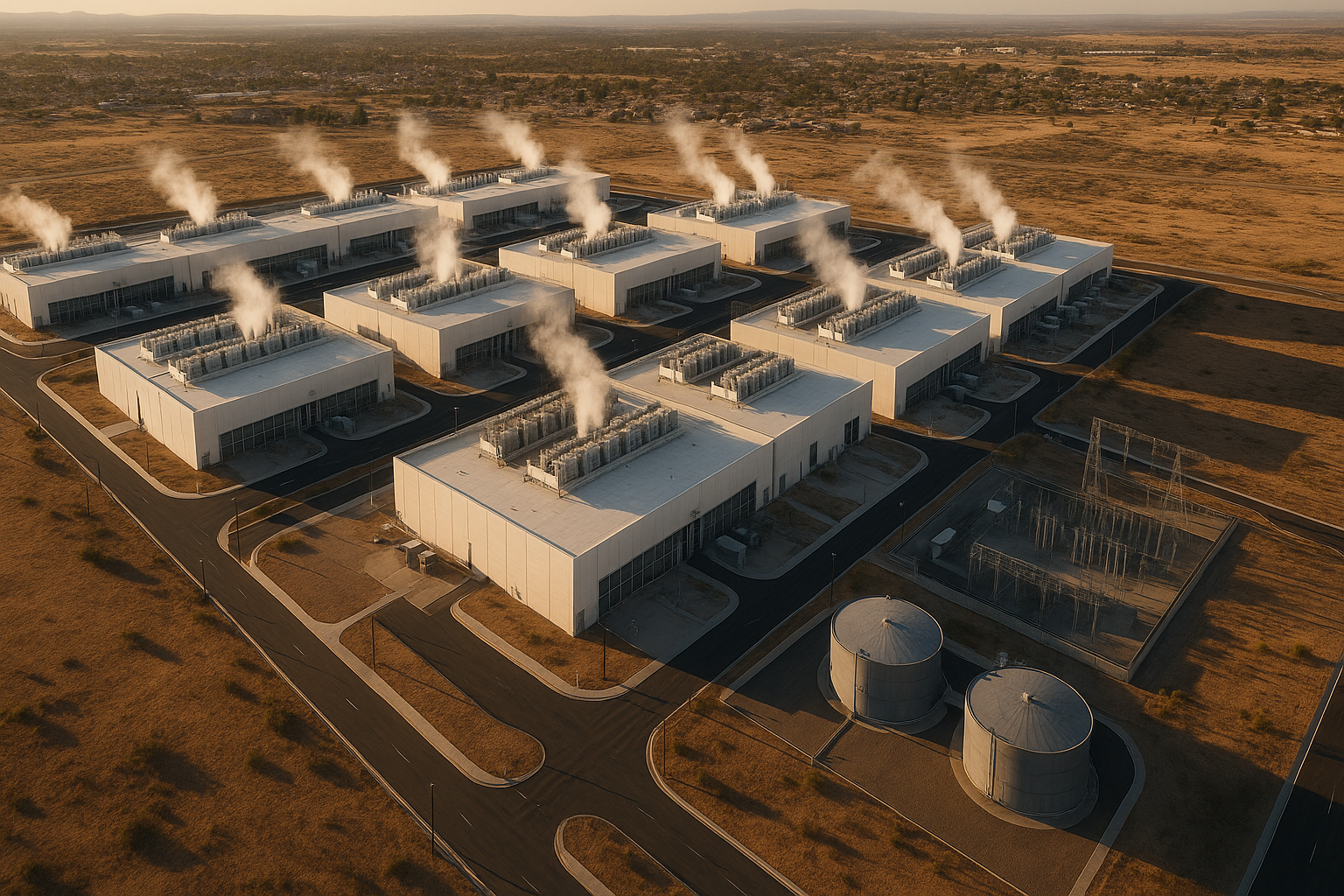
Artificial intelligence workloads are intensifying the water demands of data centres, adding a resource constraint to the sector’s rapid expansion. Operators say the bulk of direct water use stems from cooling high-density compute, while indirect water footprints also rise with electricity consumption.
Cooling strategy is central to the equation. Many sites in temperate or arid climates use evaporative systems that lower electricity use but consume freshwater. Others rely on closed-loop chillers that use little water but draw more power, shifting the burden to the grid and, by extension, to water-dependent thermal generation. As AI training and inference increase server heat output, operators are retooling facilities with direct-to-chip liquid cooling and higher-efficiency heat rejection to curb both energy and water intensity.
Company disclosures show the trend. Microsoft (NASDAQ: MSFT) reported using about 1.7 billion gallons of water in 2022, an increase it linked to growth in cloud and AI infrastructure, according to its sustainability reporting. Alphabet (NASDAQ: GOOGL), Google’s parent, reported roughly 5.6 billion gallons in the same year as it expanded data centre capacity, based on its environmental reports. Both companies have said they aim to be water positive by 2030. Amazon’s cloud arm, Amazon Web Services, part of Amazon (NASDAQ: AMZN), has also announced a 2030 water-positive target.
Local authorities and communities are scrutinising siting decisions and water rights. Planning approvals increasingly require detailed assessments of water sources, seasonal availability, and competition with agriculture or households. In some jurisdictions, utilities are setting conditions covering the use of non-potable water, heat reuse, and peak-demand management to limit stress on municipal systems.
Investors are seeking comparable disclosures. Some operators publish Water Usage Effectiveness metrics, which relate water consumption to IT energy use, but methodologies vary and do not capture offsite water impacts from electricity generation. Colocation providers such as Equinix (NASDAQ: EQIX) have expanded water stewardship reporting alongside energy and emissions data, reflecting pressure from customers that must account for environmental footprints in their own supply chains.
The indirect water footprint is material. Thermal power plants withdraw and consume water for cooling, so as AI drives electricity demand, water use at the generation level can rise even if a facility itself uses little or no process water. The balance depends on local grid mix and the availability of renewables paired with storage. Operators that procure clean power under long-term contracts are increasingly evaluating water impacts alongside carbon intensity.
Mitigation options are widening. New-builds are being designed to tap reclaimed wastewater where available, reduce reliance on potable supplies, and integrate advanced controls that optimise when and how cooling systems use water. Direct-to-chip liquid cooling can lower airflow needs and enable higher densities with less evaporative loss. In some coastal or cooler regions, facilities use seawater or ambient air more of the year, reducing freshwater consumption.
Site selection is shifting accordingly. Developers are using third-party water stress mapping, such as datasets from the World Resources Institute, to screen locations and plan for resilient sourcing. Where water stress is high, projects increasingly pair closed-loop mechanical cooling with grid decarbonisation plans and on-site energy efficiency to limit both water and carbon footprints.
For municipalities, the calculus includes jobs, tax base, and grid investment against year-round water availability. Agreements increasingly specify thresholds for potable versus non-potable use, seasonal caps, and transparency on daily draw, particularly during drought conditions. In return, operators may fund infrastructure upgrades, recycled water pipelines, or heat recovery that benefits district energy networks.
For the sector’s largest buyers of AI infrastructure, the financial stakes are growing. Capital expenditure plans for accelerated computing clusters run alongside commitments to water stewardship that will influence timelines, costs, and regional footprints. Clearer, comparable reporting is likely as global sustainability standards evolve and lenders incorporate water risk into due diligence.
- What investors should watch: disclosure of site-level water sources, potable versus non-potable use, and Water Usage Effectiveness trends.
- Evidence of progress toward water-positive pledges, including reclaimed water projects and heat reuse.
- Grid mix and power purchase agreements that reduce indirect, generation-related water impacts.
- Cooling strategy for AI clusters, including adoption of direct-to-chip liquid cooling and limits on evaporative systems in stressed basins.
- Regulatory conditions in priority regions, such as reporting requirements and drought contingency plans.
The water footprint of AI is not uniform. It varies by climate, grid composition, cooling design, and corporate procurement. As demand accelerates, the combination of technology upgrades, robust disclosure, and localised water planning will shape which AI data centre projects advance and at what cost.